


![European American Chamber of Commerce New York [EACCNY] | Your Partner for Transatlantic Business Resources](https://eaccny.com/wp-content/uploads/2020/06/eaccny-logo.png)
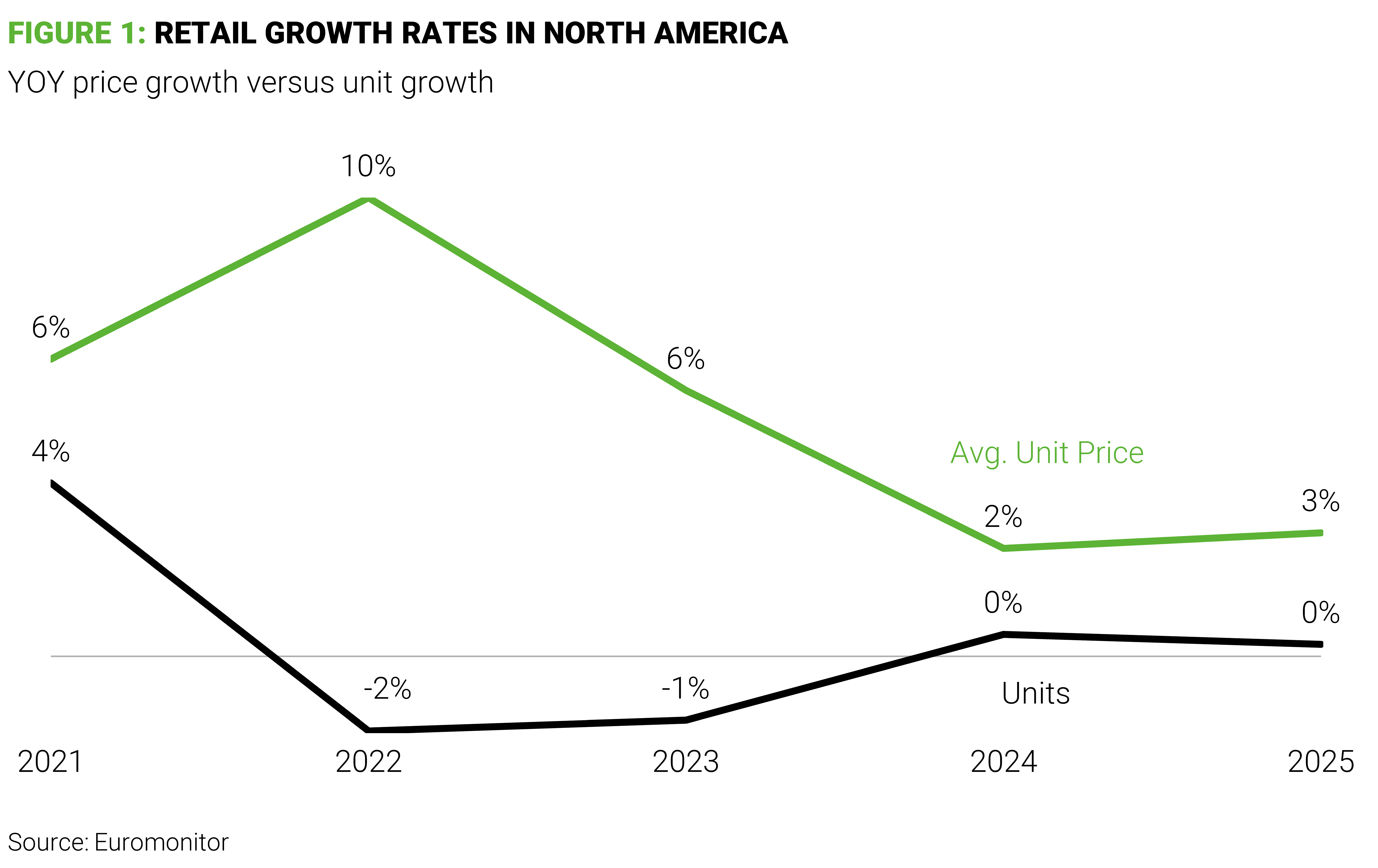
The consumer goods industry is running out of room to hide behind price. By late 2025, category volumes were slipping into decline even as retail sales stayed positive—a clear sign that topline gains are still all price, not product. With inflation pressures intensifying again from rising energy and shipping costs, pricing alone won’t cut it. The next wave of growth will have to come from something harder: winning back consumers through innovation, sharper portfolios, and flawless execution.
Why pricing is hitting a ceiling
The data tells a stark story. In nominal terms, average prices for consumer goods in North America are now almost 30% higher than in 2020, compressing close to a decade’s worth of typical price increases into just a few years. The pricing lever is effectively exhausted.
Yet volumes are only about 1% above 2020 levels, meaning nearly all value growth has come from pricing rather than genuine demand. With shoppers already trading down and budgets under pressure, additional price increases are increasingly likely to erode volume instead of driving growth.
One of the most telling signals of this is behavioral. According to a recent AlixPartners survey of value-conscious consumers in the U.S. (about 68% of all shoppers), the share who are actively buying more private label jumped 15 percentage points in a single year — from 32% in 2024 to 47% last year. That is the largest single behavioral shift observed across all grocery coping strategies. The most price-sensitive consumers are not waiting for deals. They are walking away from brands.
The implication is clear: the pricing lever is largely spent. For consumer companies to grow value from here, more shoppers need to buy more units, more frequently. That means confronting some structural issues that pricing has been masking. Several patterns show up:
- Portfolios are too broad, spreading resources across too many low-impact products and sub-brands that don’t excite consumers or matter much to retailers.
- Package sizes and price points don’t match what today’s value-conscious shoppers want or how they buy across mass, dollar, club, and online channels.
- Promotions cost more but deliver less, often just shifting sales around as consumers learn to wait for discounts instead of buying at regular price.
Alongside these pitfalls, a number of counter‑examples illustrate a better approach. When companies simplify portfolios, redesign how products are sized and priced around real shopper demands and value thresholds, and work more tightly with customers on joint plans, they reignite both volume and profit.
What’s needed now is a more systematic, volume-oriented growth engine, rather than another round of tactical price moves.
How to reignite volume-led growth
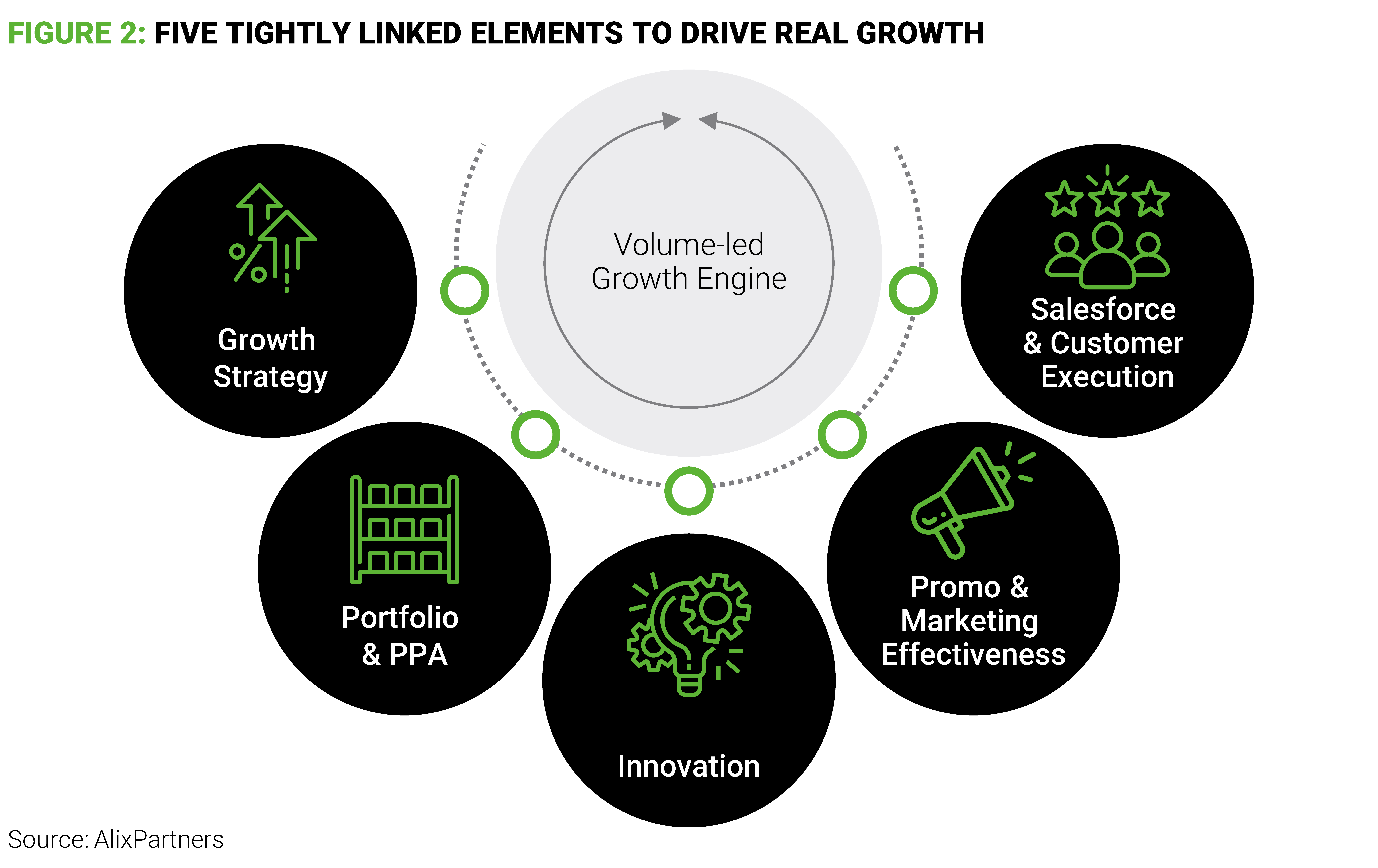
For executives, that means treating pricing, innovation, promotion, and sales as the interconnected activities that they are and focusing on five tightly linked elements to drive real growth.
1. Growth strategy
The starting point is a clear growth strategy that defines where the business will play for volume, not just value. That means making explicit choices about which categories, occasions, channels, and consumer segments represent sustainable unit growth, and which need to be managed for cash or exited. Strategy also sets objectives that track real consumption. How many householders are buying? How often do they shop? Do they come back? Tracking these metrics alongside revenue and margin ensures that teams are accountable for selling more, not simply charging more.
2. Portfolio and price pack architecture (PPA)
This combo puts that strategy to work on the shelf. Overly broad portfolios must be simplified around their strongest brands and fastest-growing product lines, freeing up investment and shelf space. Advanced analytics, powered by AI and machine learning, now enable manufacturers to model consumer demands, price sensitivities, and channel dynamics at a far more granular level—uncovering unmet needs and optimizing pack-price combinations for both shoppers and retailers. PPAs should then be redesigned to match today’s value equation: credible entry price points for stretched shoppers, compelling trade‑up options for those willing to pay more, and pack formats that support mission‑based shopping in mass, dollar, club, and e‑commerce.
3. Innovation
Innovation is the engine that keeps the engine running. The categories that are growing units are those with products that give consumers a genuine reason to buy—be that higher protein, better convenience, functional benefits, or non-guilty treats, for example—rather than “me too”‑ line extensions. When innovation is anchored in these needs and supported by the right pack and price, it enables brands to raise prices responsibly, expand distribution, and still grow volume, even in pressured categories.
4. Promo and marketing effectiveness
This is where many companies need a reset. The more companies have promoted, the less it has worked. In one category, 12 extra weeks of deeper discounts did not grow total sales. It just trained shoppers to wait for deals, eroding everyday full-price sales by more than 25%. Advanced AI‑ and machine‑learning‑driven engines now help teams predict when promotions will genuinely add value, and optimize depth, frequency, and marketing support so each event earns its place on the calendar. The growth engine approach replaces blanket deal calendars with targeted, test‑and‑learn programs that focus on incremental units, clear payback, and synergy with brand building, not just short‑term lift.
5. Salesforce and customer execution
Finally, a focus on salesforce and customer execution turns plans into reality. Retailers are themselves wrestling with what they’re selling and at what margin, and are wary of tactics that simply swap full-price sales for discounted ones. Volume-led joint business plans—grounded in incremental volume, category growth, and shopper value—give them a reason to back your brands with space, visibility, and data support, creating a reinforcing loop between your growth engine and theirs.
When the five elements of this engine are managed as a coherent system, volume starts to recover. Consumer-relevant propositions unlock penetration and frequency; targeted promo and marketing convert that into incremental units; strong customer execution amplifies distribution and visibility; and the resulting data and cash flow fund the next round of innovation and portfolio sharpening.
From narrative to execution
For leadership teams, this means building a concrete, strategic agenda around all elements of the growth engine. Healthy, repeatable unit growth, stronger retailer partnerships, and improved margins are the goals. Value growth can once again be grounded in the number of products consumers actually buy and rebuy, not just what they pay for each.
Start with a pilot. Done well, this pilot should show early proof of concept in one to two quarters: new shoppers drawn in through a stronger value equation, existing buyers coming back more often because the product line has given them a reason to, and a retail partner rewarding that momentum with better shelf placement or promotional support.
In a world of persistent inflation, geopolitical shocks, and increasingly demanding shoppers and retailers, the companies that will outperform are those that rebuild their businesses around sustainable volume growth, not just another turn of the pricing screw.
This article is the first in a series that will bring that agenda to life with diagnostics, tools, and case examples focused on volume recovery in specific categories, channels, and situations.
Compliments of AlixPartners – a Platinum Member of the EACCNY