


![European American Chamber of Commerce New York [EACCNY] | Your Partner for Transatlantic Business Resources](https://eaccny.com/wp-content/uploads/2020/06/eaccny-logo.png)
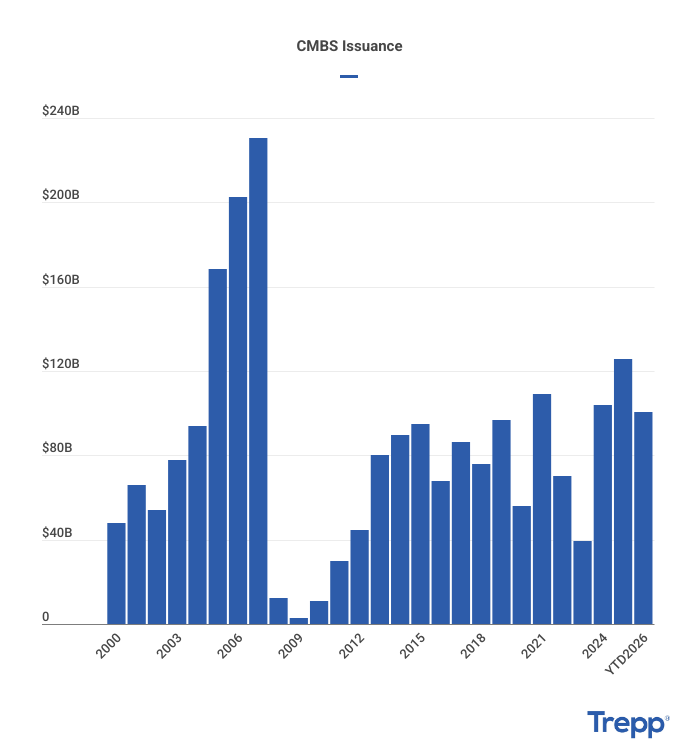
Domestic private-label CMBS issuance topped $100 billion this year through the end of September. That means 2026 is shaping up to be among the busiest years in the CMBS new-issue market since 2007, when for the full year, $230.5 billion of deals were brought to market.
As has been the case in recent years, today’s CMBS market is not your father’s CMBS market. What was developed as a mechanism to tap the capital markets to fund middle-market commercial property loans has become a favored source of financing for very large loans against class-A and trophy properties.
So far this year, $77.49 billion of deals were single-asset, single-borrower, or SASB, transactions, while only $22.89 billion have been conduits. That’s an even heavier concentration of SASB deals than all of last year, when $91.3 billion of the year’s $125.6 billion of deals were SASBs.
Since 2015, SASB deals have accounted for just more than half of every year’s total issuance on average.
The shift to SASB issuance illustrates how the CMBS market has evolved. Years ago, the large-loan business was dominated by life insurance companies, which often would form clubs to fund loans of $300 million to $500 million.
Today, loans that would otherwise have been funded by insurers are more often than not being executed through the CMBS market. To be sure, insurers still play the game, which provides a number of benefits, including greater liquidity—it’s easier to sell a rated bond than a whole loan—easier diversification, and potentially lower capital charges. But instead of originating and holding relatively illiquid whole loans, they’re increasingly holding rated bonds.
Say, for instance, an insurer originates a $500 million mortgage. It would have to set aside risk-based capital for the entire loan. If it instead buys the most-senior bonds of a SASB CMBS deal, the required capital set-aside would be smaller.
And instead of allocating $500 million to one asset, the insurer could buy bonds in five or more SASB deals, giving it exposure to a diversified pool of property types and geographies.
According to the NAIC, life insurers held about $208 billion of private-label CMBS at the end of 2024. Almost all the bonds they held carried the highest possible ratings. Other investors in SASBs include asset and money managers, banks, pension funds, and foreign investors.
CMBS Issuance
This year is shaping up to be among the frothiest in the domestic private-label CMBS issuance market since before the Global Financial Crisis. Of the more than $100 billion of new issuance so far this year, more than 77% has consisted of single-asset, single-borrower deals. In fact, SASB deals have accounted for a little more than half of annual issuance on average since 2015.
Compliments of Trepp – a Premium Member of the EACCNY