


Direct lending funds in the AIFMD II era: Almost, but not quite, an EU lending passport
The implementation of Directive (EU) 2024/927 (AIFMD II or the Directive) has now been completed in most EU Member States, marking the introduction of the first EU-wide framework specifically regulating loan origination by alternative investment funds (AIFs). It confirms that originating loans may form part of the management activity performed on behalf of an AIF, introduces harmonised conduct and product rules, and is plainly designed to support a more integrated internal market for direct lending funds. Yet AIFMD II stops short of creating a formal EU lending passport. It harmonises the regulatory conditions under which AIFMs and AIFs may engage in loan origination. However, it does not, in itself, disapply borrower-facing lending restrictions, as Member States are not required to abandon banking monopoly concepts (where applicable) and/or to open their local consumer markets.
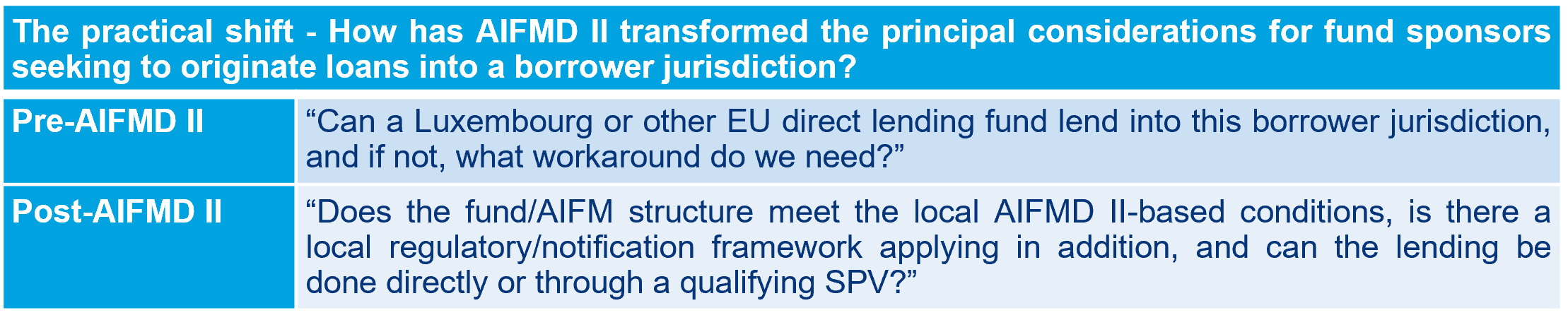
That distinction is commercially significant. Before the entry into force of AIFMD II, pan-European direct lending strategies often required a detailed jurisdiction-by-jurisdiction analysis to determine whether a fund could lend directly into a particular borrower jurisdiction and, if not, what structuring alternative would be necessary. In more restrictive markets, this frequently resulted in the use of transactional workarounds, including bond structures, fronting bank arrangements, using local fund wrappers and/or reverting to ELTIFs which offer a genuine lending passport. Such structures were often driven primarily by regulatory considerations rather than commercial objectives, leading to increased complexity and execution risk. AIFMD II does not abolish that analysis, but it changes the starting point. For fully compliant EU AIFs managed by EU AIFMs, direct lending to professional or corporate borrowers should become more streamlined in most Member States, provided local implementation is clear and workable.
The regime is therefore best understood as an “almost-passport”: a harmonised framework capable of producing passport-like effects in practice, but not a standalone right for every fund, every lending chain and every borrower jurisdiction. For managers, the central question will increasingly be not only whether the fund can lend, but whether it can lend directly, through a platform company or SPV, and under what local implementation conditions.
What AIFMD II actually harmonises
AIFMD II draws a fundamental distinction between two categories of AIFs engaged in loan origination activities. First, any AIF that originates loans is subject to the baseline regulatory framework applicable to AIFs originating loans. Secondly, a narrower category of loan-originating AIFs is subject to an enhanced set of product-level requirements where either (i) the AIF’s investment strategy is principally to originate loans, or (ii) the nominal value of the loans originated by the AIF represents at least 50% of its net asset value. This distinction is central to the architecture of the regime, as it determines the extent to which the additional obligations introduced by AIFMD II apply to a particular fund.
Loan origination is defined broadly. It covers not only direct lending by the AIF as the original lender, but also indirect origination through a third party or special purpose vehicle where the AIF or AIFM is involved in structuring the loan, defining or pre-agreeing its characteristics before gaining exposure. This is a substance-over-form concept: an originating SPV does not, by itself, remove a transaction from scope if the AIF or AIFM is economically and structurally driving the origination of the loan.
That breadth should be kept separate from secondary market acquisitions. A pure secondary purchase of a loan should generally fall outside of the loan origination activity if the AIF or AIFM was not involved upstream in the original structuring. Likewise, market participants generally treat notes, bonds and other transferable securities as outside the concept of a “loan” for AIFMD II purposes, even though the Directive does not exhaustively define the term.
The new regulatory toolkit
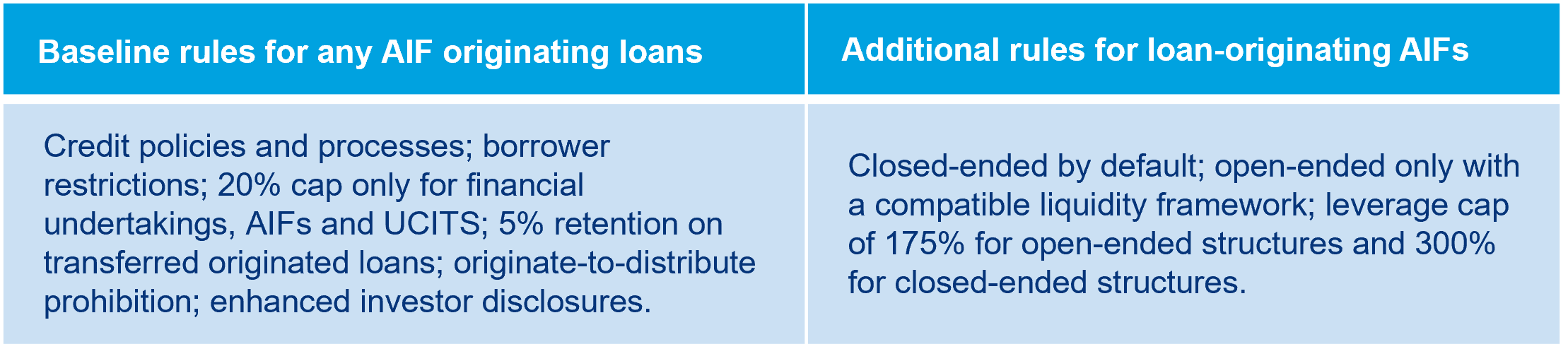
For all AIFs that originate loans, AIFMD II imposes a coherent baseline. AIFMs must maintain effective policies, procedures and processes for granting loans, assessing credit risk, administering and monitoring the credit portfolio, with regular review. The Directive also prohibits originate-to-distribute strategies where all or part of the strategy is to originate loans with the sole purpose of transferring them to third parties.
The 5% risk-retention rule is equally important in practice. Where an originated loan is transferred, the AIFM must generally ensure that the AIF retains 5% of the notional value until maturity for loans with a maturity of up to eight years, or for at least eight years for longer-dated loans, subject to specified derogations. The 20% single-borrower limit is narrower than sometimes suggested: it applies only where the borrower is a financial undertaking, another AIF or a UCITS.
Furthermore, AIFs that originate loans are subject to new disclosure requirements. In particular, all costs and expenses linked to the administration of the loans have to be disclosed to investors, together with the composition of the originated loan portfolio.
Loan-originating AIFs are subject to further constraints. They are closed-ended by default, unless the AIFM can demonstrate to its home authority that the liquidity risk management system is compatible with the fund’s strategy and redemption policy. They are also subject to leverage caps, calculated on a commitment basis, of 175% for open-ended loan-originating AIFs and 300% for closed-ended loan-originating AIFs.
Practical impact on evergreen and open-ended credit funds
Open-ended private credit strategies remain possible under AIFMD II, but they can no longer be implemented on the basis of broadly formulated liquidity assumptions. Because loan-originating AIFs should be closed-ended by default, open-ended structures are permissible, provided that the AIFM is able to demonstrate that the AIF’s liquidity management system is compatible with its investment strategy and redemption policy. For that purpose, AIFs must select at least two liquidity management tools from the list included in Annex V of AIFMD II. This pushes managers toward more deliberate calibration of notice periods, gates, suspension powers, redemption fees, swing or dual pricing and redemption-in-kind mechanics.
AIFMD II is subject to certain implementation measures, commonly known as “Level 2” regulations. Uncertainty over Level 2 has recently diminished, but has not been resolved. ESMA finalised its Guidelines on Liquidity Management Tools on 12 March 2026, — later than the 16 April 2025 target originally set by the Directive — giving managers settled expectations on the selection, calibration and activation of the Annex V toolkit for open-ended AIFs and UCITS generally. The more targeted technical standards for open-ended loan-originating AIFs specifically remain outstanding, however: the European Commission confirmed in October 2025 that it does not expect to adopt these as “non-essential” Level 2 measures before 1 October 2027 at the earliest. Managers of open-ended credit strategies now benefit from greater certainty regarding general LMT guidance. Nevertheless, further clarification is still awaited on the conditions for supporting open-ended loan origination products, underscoring the continued importance of careful ex ante structuring and documentation.
Certain managers have elected to structure evergreen strategies as closed-ended AIFs. This approach may offer a degree of regulatory flexibility, as closed-ended loan-originating AIFs are not subject to the specific liquidity management framework applicable to open-ended AIFs under AIFMD II. In particular, they are not required to implement the prescribed liquidity management policies or maintain the minimum number of liquidity management tools mandated for open-ended structures.
That flexibility, however, comes at the price of reduced investor liquidity. Unlike open-ended AIFs, which permit periodic redemptions subject to the operation of appropriate liquidity management mechanisms, closed-ended evergreen vehicles generally rely on carefully structured withdrawal frameworks, limited redemption windows, secondary transfers or other controlled liquidity features. Investor exits are therefore typically accommodated on a gradual or discretionary basis, often through run-off mechanics under which liquidity is generated from loan repayments, amortisations, refinancings or asset realisations rather than through the forced disposal of portfolio assets. As a result, the closed-ended model may enable managers to pursue evergreen investment strategies while avoiding the operational and regulatory constraints associated with the open-ended loan origination regime, albeit at the expense of providing investors with more limited and less immediate liquidity options. These products are particularly attractive to institutional investors, but less so to the private wealth or “semi-retail” investors who generally require stronger liquidity features, typically available through open-ended fund structures.
Why AIFMD II is almost a lending passport
The policy direction of AIFMD II is unmistakable. Recital 13 states that common rules should establish an efficient internal market for loan origination by AIFs, make it possible for AIFs to develop their activities by originating loans in all Member States, and facilitate access to finance by small and medium-sized enterprises, for which traditional lending sources are more difficult to access. This language goes beyond a mere recognition of an existing market trend. Rather, it reflects a clear legislative objective to foster cross-border lending activities by investment funds within a harmonised European framework and to promote greater integration of the EU private credit market. The loan origination regime introduced by AIFMD II should therefore be understood not as a collection of isolated prudential measures, but as part of a broader policy initiative aimed at creating the regulatory conditions necessary for a genuinely pan-European market for fund-based lending.
For transaction execution, this matters immediately. A manager of an EU AIF managed by an EU AIFM can now rely on an EU rulebook specifically governing loan origination. Against that background, the justification for maintaining or introducing additional national restrictions on lending by such funds is materially diminished, particularly where the lending is directed to corporate borrowers and the fund operates in compliance with the harmonised requirements of AIFMD II. In this respect, AIFMD II strengthens the argument that loan origination by qualifying EU AIFs should be capable of being conducted on a cross-border basis without being subject to duplicative or inconsistent local regulatory constraints.
The commercial implications of AIFMD II are potentially significant. By introducing a harmonised framework for loan origination activities, AIFMD II has the potential to shift the market away from complex, workaround-driven structures historically required to lend into certain jurisdictions into a more direct and streamlined lending model. The new regime provides market participants with a clearer regulatory basis upon which EU AIFs managed by authorised EU AIFMs may engage in loan origination activities across the Union.
Accordingly, in jurisdictions that implement AIFMD II in a manner that recognises the ability of such funds to originate loans without being subject to additional local licensing or authorisation requirements, the regime may, as a practical matter, achieve effects comparable to those of a passporting framework. Whilst AIFMD II does not establish an express lending passport as a matter of law, its harmonised rules and cross-border market integration objectives may substantially facilitate the provision of lending activities throughout the European Union and reduce the need for jurisdiction-specific structuring solutions.
Why it is not quite a lending passport
The legal limit here is equally clear: AIFMD II does not create a standalone lending licence. The existing AIFMD passport is a management and marketing passport for AIFMs – it is not a borrower-facing authorisation regime for the AIF as lender. Recital 13 also preserves Member States’ ability to maintain national product frameworks with more restrictive rules. Equally, Member States retain full discretion over access of direct lending funds to their domestic consumer market. AIFMD II therefore harmonises the regulatory framework for loan origination at the AIF and AIFM level, but it does not automatically displace national banking monopolies, consumer protection rules, security enforcement regimes, or reporting obligations. ESMA’s 2025 Final Report on the draft RTS for open-ended loan-originating funds provides particularly important institutional confirmation that AIFMD II does not create a genuine passport for loan origination activities. In the context of open-ended loan-originating AIFs, ESMA expressly noted that AIFMD does not harmonise fund authorisation requirements and acknowledged that certain funds may continue to be subject to national pre-authorisation regimes.
A further decisive implementation question is whether national laws clearly extend the relevant lending exemption or authorisation not only to the AIF itself, but also to SPVs or platform companies acting for or on behalf of the AIF. This is important because credit funds routinely use platform or blocker vehicles to secure tax treaty benefits, mitigate withholding taxes, manage investor allocation mechanics, and structure the security package, including pledges and collateral arrangements, associated with the loans they originate.
This implementation-dependence is not uniform across fund types, however, and the position of ELTIFs should be distinguished. The ELTIF Regulation restricts Member States from imposing additional requirements that would undermine qualifying ELTIF lending to eligible borrowers — which, in our view, can produce an outcome functionally similar to a lending passport where the ELTIF conditions are met. Ordinary AIFs, by contrast, remain more dependent on AIFMD II transposition and local lending-law implementation. While the policy case for restrictive gold-plating should weaken after AIFMD II, the legal analysis remains considerably more implementation-dependent for ordinary AIFs than for qualifying ELTIFs.
The SPV question: the remaining frontier
Special purpose vehicles (SPVs) sit at the heart of the “almost, but not quite” nature of the AIFMD II loan origination framework. On the one hand, the Directive adopts a deliberately expansive approach to the concept of loan origination. AIFMD II captures not only loans granted directly by an AIF, but also loans originated indirectly through a third party or an SPV where the origination has been structured, arranged or pre-agreed by the AIF or its AIFM. The clear legislative intent is to prevent the use of intermediary vehicles as a means of circumventing the loan origination regime. Accordingly, the mere interposition of an originating SPV does not remove a transaction from the scope of the AIFMD II framework.
Relatedly, another question arises where an SPV is not used as the origination vehicle but instead becomes the holder of the loan following a transfer from the original lender of record, as part of the implementation of the fund’s investment strategy. In this scenario, would that transfer be regarded as inconsistent with the “originate-to-distribute” prohibition, and should the AIFMD II risk retention framework apply? As noted above, credit funds frequently utilise holding companies, blocker entities, warehousing vehicles and security-holding structures for legitimate commercial, tax, financing and operational reasons. In such circumstances, the key question is whether the relevant transfer represents a genuine disposal of the loan to an independent third party or merely an internal allocation within the broader fund architecture. Where the vehicle is established by or on behalf of the AIF, remains under the control of the fund structure, and serves exclusively to facilitate the execution of the investment strategy, there are compelling policy and technical grounds for treating the arrangement as an internal structuring step rather than as a transfer to a third-party acquirer for the purposes of the retention and originate-to-distribute rules. A possible illustration is the transfer of loan exposures across parallel funds (and their respective SPVs) to achieve an allocation proportionate to their respective commitments. This should not, in itself, be regarded as a genuine third-party transfer, as the rebalancing is required to implement the investment strategy of the fund complex as a whole. Furthermore, while separate GPs or management entities are often used for parallel funds (for example, where a Cayman and Luxembourg sleeve are involved), these are typically affiliated entities under the control of the same sponsor, which further supports the absence of a true third-party relationship.
That conclusion should not, however, be understood as granting managers carte blanche to deploy SPVs without regulatory scrutiny. In an AIFMD II environment, the governance and operational rationale of each SPV becomes part of the regulatory analysis. Managers should be able to demonstrate the commercial purpose of the vehicle, the nature and extent of the AIF’s control, the allocation of decision-making authority, the flow of proceeds and fees, and the manner in which the structure supports and remains consistent with the fund’s disclosed investment strategy. The documentary record supporting those conclusions may prove as important as the legal analysis itself.
The transparency obligations introduced by AIFMD II further reinforce that conclusion. AIFMs are required to provide investors with annual disclosures regarding SPVs utilised in connection with the AIF’s investments, thereby bringing such vehicles squarely within the regulatory reporting perimeter. As a practical matter, the SPV governance file increasingly becomes part of the fund’s regulatory file. Equally critical will be the treatment of such vehicles under national implementation measures. As Member States transpose AIFMD II, the extent to which platform entities, holding companies and other SPVs can qualify as permissible lending vehicles, or otherwise fall within the scope of relevant exemptions, is likely to become a key structuring consideration for direct lending managers operating on a cross-border basis.
Local implementation: from legal obstacle to execution variable
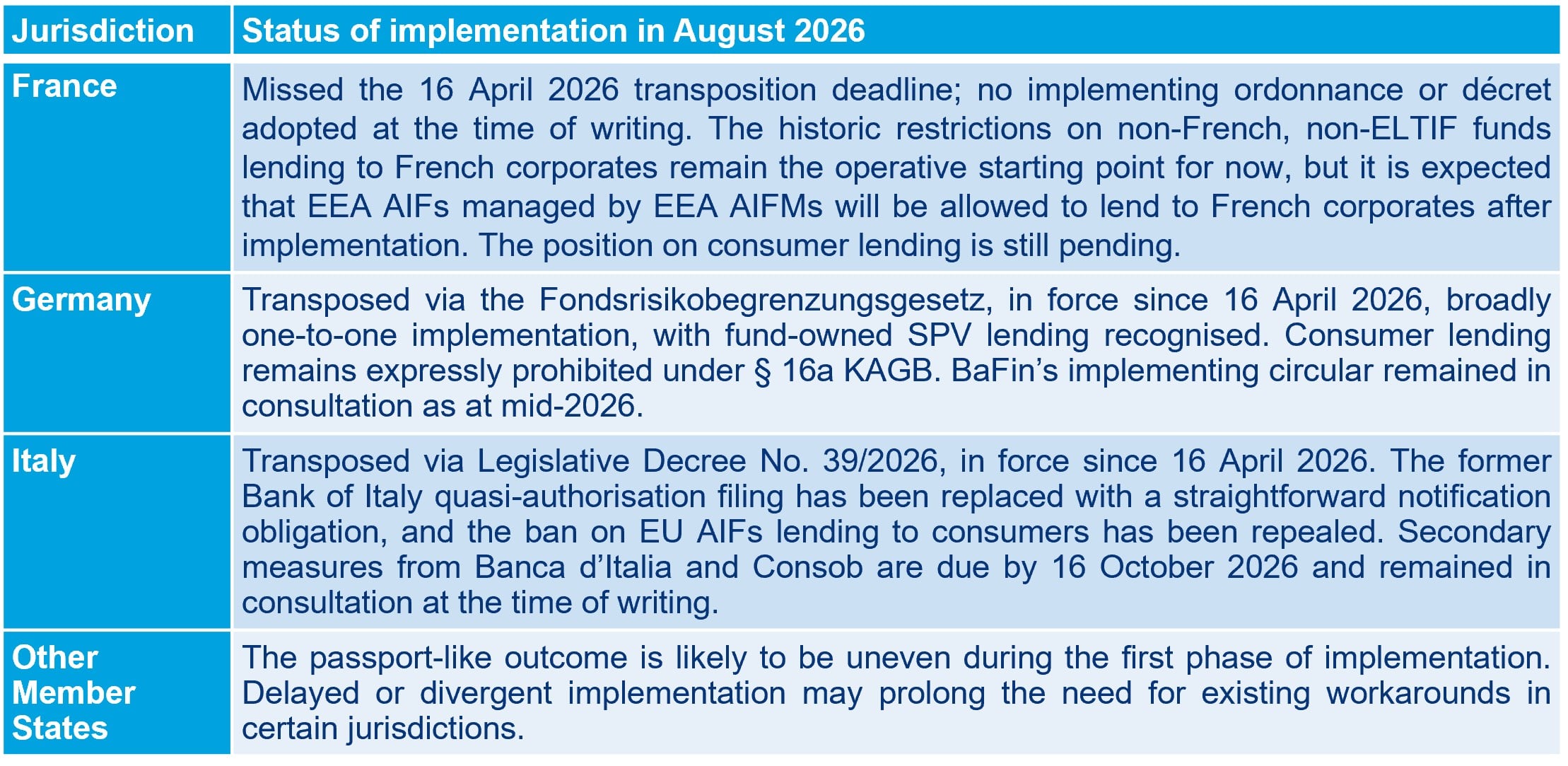
The map of national implementation is no longer prospective — it is a live, and genuinely uneven, patchwork. The 16 April 2026 transposition deadline has passed, and most EU Member States, including Luxembourg, Germany and Italy, have already adopted and brought into force implementing legislation, each transposing the Directive largely faithfully but with country-specific choices at the margin. Luxembourg’s transposing law, for example, restricts both Luxembourg and foreign AIFs from granting consumer loans to consumers located in Luxembourg, without otherwise gold-plating the Directive. Germany’s Fund Risk Limitation Act took a similar approach and transposes AIFMD II broadly one-to-one and reinstates the existing ban on consumer lending in the Capital Investment Code. A notable and welcome development is the extension of the local banking licence exemption available to EEA AIFs managed by EEA AIFMs to their controlled SPVs.
Italy illustrates a material evolution of the existing local framework. Legislative Decree No. 39/2026 replaced the historical Bank of Italy filing — which had operated, in substance, as a quasi-authorisation process — with a straightforward notification obligation at the commencement of lending operations, and repealed the pre-existing ban on EU AIFs originating consumer loans in Italy. That is a genuine liberalisation of the Italian position for EU direct lending funds. It is not, however, the end of the story: Banca d’Italia and Consob are required to adopt secondary implementing measures by 16 October 2026, and a market consultation on those measures remained open at the time of writing. Managers relying on the new Italian regime should treat the notification-only model as settled in principle, but the operational detail as still subject to change.
By contrast, France — historically one of the more restrictive jurisdictions for non-French lenders — missed the 16 April 2026 deadline altogether. As at the date of this briefing, no implementing ordonnance or décret had been adopted, and the AMF had not issued detailed supervisory guidance; the timing and shape of the French regime therefore remain open questions. At present, lending to French corporate borrowers through a fund structure generally requires the use of a French fund vehicle, with ELTIFs representing the only recognised exception. It is expected that this restrictive framework will be relaxed, allowing AIFMD II-compliant EEA AIFs managed by EEA AIFMs to lend directly to French corporate borrowers. A key remaining question is whether SPVs controlled by such funds will also qualify as permitted lenders. Again, this expected direction of travel remains subject to confirmation in the draft implementing legislation, once available.
Belgium implemented AIFMD II through the Law of 22 July 2026. Notably, and unlike a number of other Member States, Belgium has elected not to avail itself of the option afforded by AIFMD II to prohibit AIFs from originating loans to consumers. Accordingly, AIFs remain permitted to extend consumer credit under Belgian law, subject to obtaining the requisite authorisation and complying with the applicable provisions of the Belgian Code of Economic Law. Furthermore, Belgium has not introduced any material gold-plating measures in connection with the transposition of AIFMD II and has largely adhered to the harmonised framework contemplated by AIFMD II.
According to the latest trackers, Spain is also behind schedule in transposing AIFMD II. For managers with live or contemplated lending into Spain, the practical question today remains closer to the pre-AIFMD II question — can this fund lend here and, if not, what workaround is required?
For non-ELTIF EU AIFs managed by EU AIFMs, the analysis should nonetheless continue to shift, jurisdiction by jurisdiction, from whether lending is possible at all to whether the relevant EU AIF/AIFM structure satisfies the conditions of the local exemption, whether any notification is required, and whether lending may be carried out directly and/or through a platform vehicle. Historically, Germany, France and Italy have been regarded as jurisdictions with particularly restrictive lending regimes, often requiring market participants to rely on alternative transaction structures to lend to local borrowers, such as bond issuances, fronting bank arrangements or the use of local fund vehicles. At the date of writing, Germany and Italy have clearly relaxed their domestic frameworks, and the market is hopeful that France will follow suit. Critically, it should also be noted that non-EU AIFs, and AIFs managed by non-EU AIFMs, will still need to assess whether the relevant local regulatory frameworks permit lending to local borrowers. The expectation remains, however, that regulatory barriers will continue to exist in a number of EEA jurisdictions (including France, Italy and Germany). As a result, workaround solutions are likely to be required for non-EEA sponsors in order to access local borrowers.
How loan origination transactions may change
AIFMD II will not only affect fund documentation and compliance policies. It may also change the anatomy of direct lending transactions. In historically difficult jurisdictions, managers may be able to move from defensive, workaround-driven structures to more streamlined origination models, provided local implementation is sufficiently clear. We expect the post-AIFMD II implementation landscape to result the following changes:
- Less reliance on transaction workarounds (i.e. bond structures/fronting banks): In France and Italy in particular, bond structures have often been used because direct loan origination by a foreign (even an EU-based) credit fund was restricted or procedurally burdensome. If an EU AIF or qualifying platform vehicle can originate loans directly under an AIFMD II-based local regime, there may be less need to recharacterise financing as a bond issuance merely to avoid lending restrictions. Equally, fronting bank arrangements may become less central where EU AIFs are expressly permitted to lend to corporates. Banks will, of course, remain relevant for syndication, agency, security, payment, regulatory or commercial reasons.
- Fewer local credit fund wrappers: Managers may have less need to establish local AIF products solely to access borrowers in restrictive jurisdictions, although local wrappers may still be useful for tax, investor, regulatory or commercial reasons.
- More streamlined lending processes: As local restrictions are progressively removed or relaxed, managers should be able to implement a largely streamlined and harmonised lending process across their target jurisdictions, with only limited transaction-specific workarounds remaining where required.
- Less traction for ELTIFs: The lending passport attached to the ELTIF regime may become less attractive if ‘ordinary’ AIFs can efficiently lend across Europe as these are not subject to the tighter diversification and leverage requirements under the ELTIF framework.
- More disciplined use of SPVs: SPVs will not disappear. They are often needed for tax, financing, investor allocation or operational reasons. The key question will be whether the SPV can rely on, or fall within, the AIFMD II-based local lending permission.
- Greater focus on transaction evidence: Credit files, investment committee materials and SPV governance should evidence that the lending activity is carried out within the AIF/AIFM framework and not by an unauthorised standalone lender.
- Earlier regulatory structuring: Borrower-jurisdiction lending analysis, lending chain eligibility and SPV treatment should be assessed at the term sheet stage, not after commercial terms are agreed.
Practical consequences for managers
The practical consequences for managers are therefore broader than a simple compliance update. AIFMD II changes the questions that should be asked at product design, investment execution and portfolio management levels. Managers will need to determine not only whether their funds fall within the loan-origination framework, but also whether their documentation, governance, lending-chain architecture and local law controls support the intended lending model.
With that in mind, the following checklist highlights a number of key considerations that credit fund managers should review in order to assess the compliance of their AIFs with the requirements of AIFMD II:
- Map whether existing and planned funds fall within the definition of a loan-originating AIF or merely originate loans as part of a broader strategy.
- Review investment restrictions, leverage wording, single-borrower concentration limits, borrower eligibility and disclosure language in fund documents.
- Determine whether each strategy should be closed-ended or whether an open-ended structure can be justified by a credible liquidity framework.
- Update risk-retention, loan sale, syndication, co-investment, parallel fund and AIV allocation policies.
- Review delegation, credit underwriting, valuation, risk management and monitoring processes, including the AIFM’s oversight of portfolio managers or advisers.
- Create or refresh a borrower-jurisdiction lending law matrix distinguishing direct fund lending from lending through platform companies or SPVs.
- Identify jurisdictions where traditional workarounds may no longer be needed and jurisdictions where they remain advisable pending clearer implementation.
- Ensure that SPV governance, substance, board decision-making and transaction documents support the conclusion that the SPV is acting for, or on behalf of, the AIF within the AIFMD II framework.
- Assess transitional relief for legacy funds, existing loans and funds launched before the relevant cut-off dates.
Conclusion
AIFMD II marks a genuine milestone in the regulatory maturation of European private credit. For the first time, AIFs and their managers have a common EU rulebook governing loan origination, and that rulebook materially strengthens the case for cross-border direct lending by EU AIFs managed by EU AIFMs. It is not, however, a complete lending passport. Whether a fund can lend directly into a given borrower jurisdiction still turns on national lending law, supervisory practice, and — critically — how that jurisdiction treats SPV and platform-based lending chains. As the first wave of national implementation demonstrates, this shift is proving to be far from uniform. Nevertheless, the industry will welcome the easing of local regimes in jurisdictions historically regarded as having restrictive frameworks. Italy’s decision to abandon its quasi-authorisation regime and Germany’s extension of the banking licence exemption to controlled SPVs are clear indications of a broader trend towards a more streamlined and accommodating regulatory landscape. Attention is now particularly focused on France, with market participants hoping that EEA-compliant funds will finally be recognised among the categories of eligible lenders.
The right conclusion is therefore both optimistic and disciplined. AIFMD II should reduce the need for defensive, workaround-driven structuring but — it does not eliminate the need for structuring analysis. Managers who correctly map their funds against the loan-origination framework, calibrate liquidity for open-ended strategies, update their loan-origination and risk-retention controls, evidence SPV governance, and test borrower-jurisdiction implementation early in the deal process will be best placed to capture the Directive’s passport-like effects — without overstating what the law, as implemented today, actually delivers.
Contact us
If, following this publication, you would like further information or a more detailed explanation of one or more of the topics discussed, please feel free to contact your Loyens & Loeff adviser or the advisers listed below.
Compliments of Loyens & Loeff – a member of EACCNY