


![European American Chamber of Commerce New York [EACCNY] | Your Partner for Transatlantic Business Resources](https://eaccny.com/wp-content/uploads/2020/06/eaccny-logo.png)
Click here to access the interactive chart
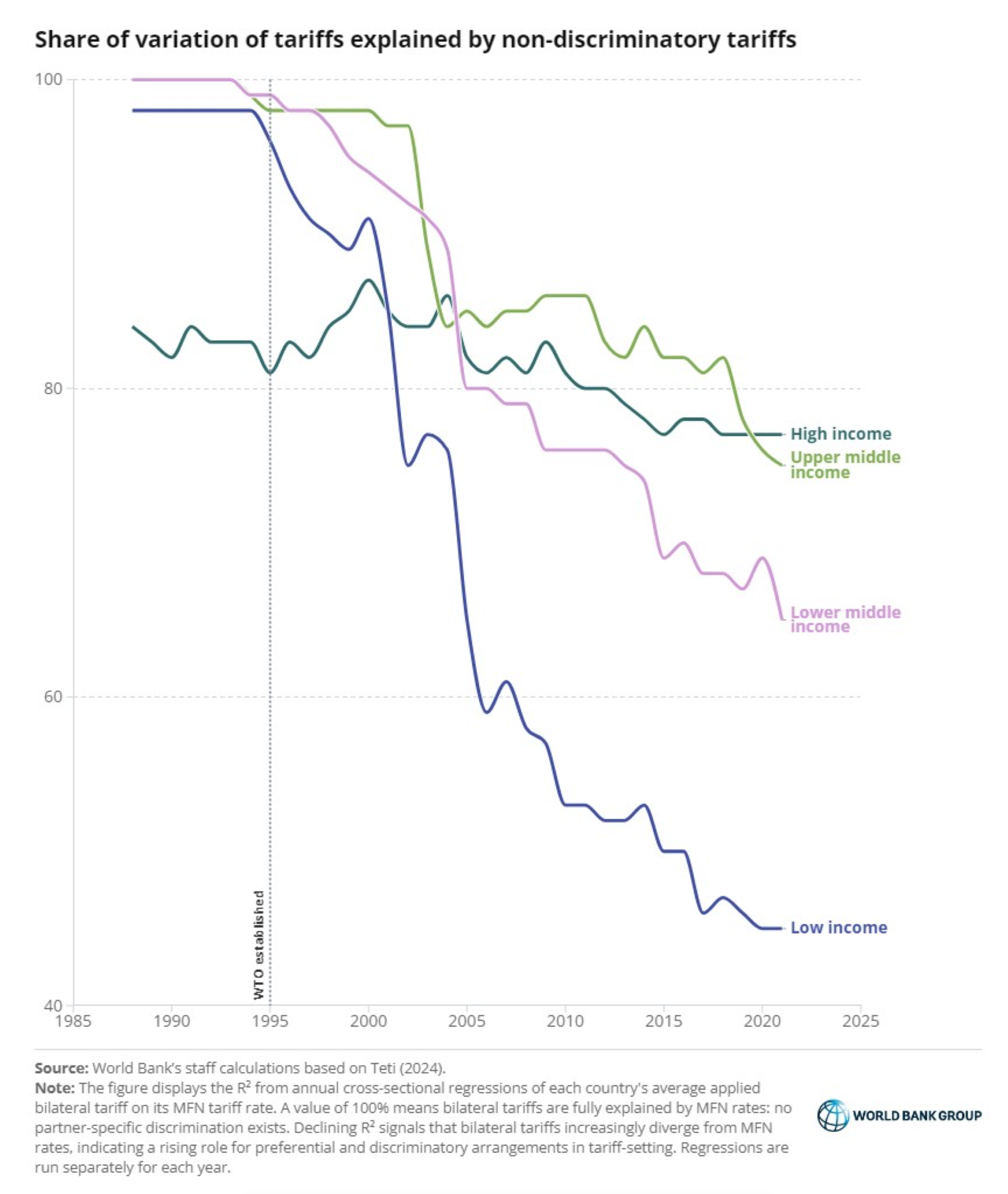
Since the WTO was established in 1995, no new multilateral trade agreement has been reached on import tariffs. Instead, we see a rise in trade policy fragmentation. This is reflected in the chart, where the downward-sloping lines show that non-discriminatory, or Most Favored Nation, tariffs explain a declining share of tariff variation. In other words, countries are increasingly applying different tariffs to different partners for the same product.
This trend appears across income groups, but it is more pronounced among low-income countries. This does not necessarily mean greater restrictiveness, as many countries have signed preferential trade agreements with selected partners, lowering tariffs between them while leaving others unchanged.
The rise in trade policy fragmentation allows countries to change policies quickly. In recent years, this has been accompanied by a rise in trade policy uncertainty.
Compliments of the World Bank