


![European American Chamber of Commerce New York [EACCNY] | Your Partner for Transatlantic Business Resources](https://eaccny.com/wp-content/uploads/2020/06/eaccny-logo.png)
Keynote Speech by Philip R. Lane, Member of the Executive Board of the ECB, at the Danish Economic Society Conference
Kolding, 9 January 2026
I am grateful to the Danish Economic Society for the invitation to participate in this conference. In line with the overall theme of the event, I will speak today about the implications of a changing world for the euro-denominated monetary system.
In our 2025 assessment exercise that reviewed the monetary policy strategy of the ECB, the Governing Council concluded that:
“Ongoing structural shifts related to geopolitics, digitalisation, artificial intelligence, demography, the threat to environmental sustainability and changes in the international financial system suggest that the inflation environment will remain uncertain and potentially more volatile, with larger target deviations in both directions, posing challenges for the conduct of monetary policy. A more resilient financial architecture – supported by progress on the savings and investments union, the completion of banking union and the introduction of a digital euro – would also support the effectiveness of monetary policy in this evolving environment.”
In addition to their implications for monetary policy, this set of structural factors will also re-shape labour markets, investment dynamics, productivity and the financial system. In what follows, I will focus my attention on how structural changes might affect the euro monetary system.
Monetary Union: Common Shocks and Scale Economies
By and large, the structural changes facing Europe can be interpreted as common shocks. While each country might face some specific challenges, forces such as revisions to the global geopolitical equilibrium (including the global trading system), digitalisation, AI, demography, climate change and shifts in the international financial system have broadly similar implications across EU Member States.
Under such circumstances, a monetary union acts as an embedded coordination mechanism by enabling that a common monetary policy can respond effectively to the evolution of common trends and common shocks.
Moreover, the identified structural changes are arguably more easily handled in a larger-scale monetary system than under the hypothetical alternative of a collection of standalone national monetary systems. First, all else equal, a larger-scale monetary system means that a greater proportion of trade and financial transactions will be denominated in domestic currency – both among domestic counterparties and with external counterparties. In turn, this provides considerable insulation against shifts in the exchange rate or changes in foreign monetary systems. Chart 1 illustrates the high euro invoicing share in trade involving euro area member countries: there is a strong positive correlation between the importance of the euro area as an export destination and the invoicing share of the euro.[1]
Chart 1
Share of exports to the euro area and euro export invoicing share
(x-axis: share of exports to euro area, percentages; y-axis: euro export invoicing share, percentages)
Sources: ECB staff calculations based on analysis in Boz, E. et al. (2025), “Patterns of Invoicing Currency in Global Trade in a Fragmenting World Economy”, Working Papers, No 178, IMF, September, and expanded and updated data from Boz, E. et al. (2022), “Patterns of invoicing currency in global trade: New evidence”, Journal of International Economics, Vol. 136, May; Taiwan Ministry of Finance; IMF Direction of Trade Statistics; and World Development Indicators. Notes: Data are averaged over the period 1999-2023. Country names on the chart are displayed as three-letter ISO codes.
Second, the existence of considerable fixed costs in running the market infrastructure and payment systems that underpin the monetary system means that larger-scale monetary systems can be operated more efficiently.[2] Large-scale monetary systems also have the capability to reduce dependencies on external providers of infrastructural services. In addition, large-scale monetary systems can afford to undertake infrastructural innovations that might not be viable for smaller-scale monetary systems.
This means that the automation and digitalisation of the financial system can be accompanied and reinforced by investment projects that ensure that central bank money can adapt to such innovations. A prime example is the digital euro project that, if the supporting legislation is adopted, will provide retail central bank money in digital form.[3] It also includes the Pontes/Appia projects that aim to ensure that settlement in central bank money can play its essential role in the future-ready, innovative and integrated financial ecosystems that can best exploit the opportunities promised by technological development in the financial system. For smaller-scale monetary systems, such projects would be more daunting and incur higher unit costs, increasing the likelihood of transactions migrating to foreign-currency systems.
Third, scale matters for the efficiency, breadth and liquidity of the financial system. Euro area residents can allocate assets across borders within the euro area without taking on currency risk, which is especially relevant for the money market, the bond market and the banking system.[4] Chart 2 illustrates the high area-wide integration in these markets.
Chart 2
Price-based financial integration indicators by market segment
(monthly data, January 1995 – October 2025; January 1995 – September 2025 for the banking sub-index)
Sources: ECB and ECB calculations.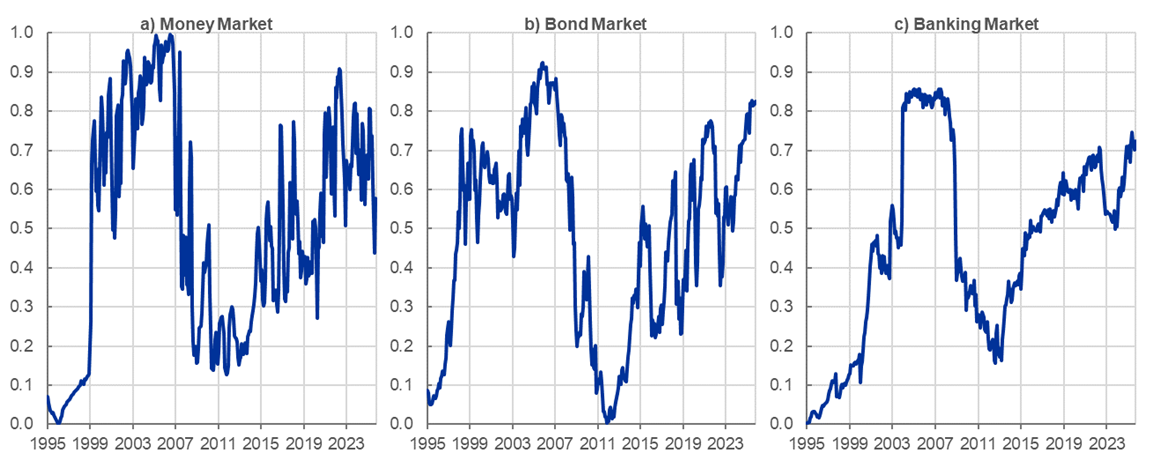
Notes: See also the report “Financial Integration and Structure in the Euro Area” and the Statistical Annex document on the ECB webpage Indicators of financial integration and structure in the euro area.
In addition, a larger market is also more attractive for foreign investors and foreign issuers, especially since the availability and cost of hedging instruments are scale-dependent. A larger market also makes it more feasible to fund supranational initiatives such as the Next Generation EU (NGEU) programme and other EU bond issues, as well as bonds issued by the European Stability Mechanism and the European Investment Bank.
These scale benefits from a monetary union are at risk if internal imbalances and financial fragilities give rise to fragmentation dynamics. These lessons were learned at a high cost during the sequence of crises over 2008-2013. However, the euro area financial architecture is now far more resilient, thanks to the significant institutional reforms that were introduced in the wake of these crises and the track record of financial stability Europe has shown over the last decade.[5]
The list of reforms include: an increase in the capitalisation of the European banking system; the joint supervision of the banking system through the Single Supervisory Mechanism; the adoption of a comprehensive set of macroprudential measures at national and European levels; the implementation of the Single Resolution Mechanism; the narrowing of fiscal, financial and external imbalances; the introduction of the fiscal backstops provided by the European Stability Mechanism; solidarity shown during the pandemic through the innovative NGEU programme; the demonstrated track record of the ECB in supplying liquidity in the event of market stress; and the expansion of the ECB policy toolkit (Transmission Protection Instrument, Outright Monetary Transactions) to address a range of liquidity tail risks.
As illustrated in Chart 3, the improved resilience has increased the role of common factors in driving the euro area bond market, with much less volatility in inter-country spreads in recent times.
Chart 3
Ten-year sovereign bond spreads vs Germany
(percentage points)
Sources: LSEG and ECB calculations. Notes: The spread is the difference between individual countries’ ten-year sovereign yields and the ten-year yield on German Bunds. The latest observations are for 2 January 2026.
An Increasing Global Role for the Euro?
The events of 2025 have prompted much discussion of possible shifts in the international monetary system. In particular, a more domestically oriented US economy suggests that the US dollar will offer a less effective hedge against global risks.[6] For euro area investors, this might translate into a lower portfolio allocation to dollar assets and/or increased currency hedging of dollar positions, with a greater “euro home bias” in financial holdings. For global investors, it might entail a somewhat lower portfolio allocation to dollar assets and a somewhat higher portfolio allocation to the euro as the “next best” international currency. While the dollar should remain by far the largest international currency, there is some scope for a shift towards a less unipolar international monetary system.
Across a range of metrics, the euro is firmly established as the second-largest international currency (Charts 4 and 5). In relation to the raising of debt (bonds and loans), Tables 1 and 2 illustrate some of the largest euro-denominated issuances in 2024 by external entities.
Chart 4
The euro is the second-largest international currency
(percentages)
Sources: Bank for International Settlements; IMF; CLS Bank International; Ilzetzki, E., Reinhart, C. and Rogoff, K. (2019), “Exchange Arrangements Entering the Twenty-First Century: Which Anchor will Hold?”, The Quarterly Journal of Economics, Vol. 134, No 2, pp. 599-646; and ECB staff calculations. Notes: The latest data on foreign exchange reserves, international debt, international loans and international deposits are for the fourth quarter of 2024. Global payment currency (SWIFT) data are as of December 2024. Foreign exchange turnover data are as of April 2025. The US dollar is not shown in the chart. *Since transactions in foreign exchange markets always involve two currencies, foreign exchange turnover shares add up to 200%.
Chart 5
Share of the euro in global foreign exchange reserves
(percentages; at constant Q4 2024 exchange rates)
Sources: IMF and ECB staff calculations. Notes: The vertical line is for 1 October 2016, i.e. when the Chinese renminbi was first identified as a reporting currency in IMF data. Previously, its share was included under the remaining currencies, denoted as “Other currencies excluding USD’’ in the chart. The latest observations are for the fourth quarter of 2024.
Table 1
Largest euro-denominated international bonds issued in 2024
|
|
|
|
|
|
|
|
|
|
|
|
|
|
|
|
|
|
|
|
|
|
|
|
|
|
|
|
Sources: Dealogic and ECB staff calculations.
Table 2
Largest euro-denominated international loans issued in 2024
|
|
|
|
|
|
|
|
|
|
|
|
|
|
|
|
|
|
|
|
|
|
|
|
|
|
|
|
Sources: Dealogic and ECB staff calculations.
There are also some signs of a step up in demand for euro-denominated assets (and in the hedging back to euro of dollar exposures) during 2025. As illustrated in Chart 6, the shift in international debt flows was largely concentrated in the second quarter.
Chart 6
Net foreign investment in debt securities of euro area non-monetary financial institutions
(flows as a percentage of the previous year’s annual GDP)
Sources: ECB (balance of payments and international investment positions), Eurostat and ECB calculations.
Note: The latest observations are for the third quarter of 2025.
Of course, much of the adjustment took the form of a level shift in the EUR/USD rate, with the euro appreciating against the dollar by 9 per cent (1.08 to 1.18) during the second quarter. According to a BVAR model maintained by ECB staff (Chart 7), much of this appreciation can be attributed to a risk sentiment factor, reflecting some mix of a decline in risk sentiment towards the dollar and an improvement in risk sentiment towards the euro.
Chart 7
BVAR historical decomposition of the drivers behind the USD/EUR exchange rate
(percentages; increase = appreciation of the euro)
Sources: Haver and ECB staff calculations. Notes: The model extends a Bayesian vector autoregression (BVAR) (Farrant, K. and Peersman, G. (2006), “Is the Exchange Rate a Shock Absorber or a Source of Shocks? New Empirical Evidence”, Journal of Money, Credit and Banking, Vol. 38, No 4, pp. 939-961) to include seven endogenous variables: USD/EUR rate, relative GDP, relative CPI, relative two-year yields (euro area-United States), euro area GDP, euro area CPI and euro area two-year yields. Quarterly data (from the first quarter of 1999 to the third quarter of 2025) are entered in first differences. The model includes four lags and a constant, estimated via Bayesian methods following Korobilis, D. (2022), “A new algorithm for structural restrictions in Bayesian vector autoregressions”, European Economic Review, Vol. 148. A tightening euro area (US) monetary policy shock is assumed to increase euro area (US) interest rates more than in the United States (euro area) and to reduce euro area (US) GDP growth and inflation more than in the United States (euro area), while causing the euro to appreciate (depreciate) against the dollar. A risk sentiment shock assumes that stronger investor sentiment towards the euro causes the euro to appreciate, weighing on inflation and growth, which lowers euro area yields (more than US yields). The latest missing GDP observations are projected; shocks are identified via sign restrictions. The latest observations are for the third quarter of 2025.
Chart 8 shows that 2025 was also a strong year for euro-denominated bond issuance by external firms.
Chart 8
Net issuance of euro-denominated bonds by non-euro area corporations
(accumulated flows in EUR billions since the beginning of each year)
Sources: ECB (centralised securities database) and ECB calculations. Notes: Figures are not seasonally adjusted. The latest observations are for November 2025.
The benefits of such an increase in euro asset demand would be larger if Europe undertook reforms to increase the scale of high-quality euro asset supply.[7] Most importantly, pro-growth economic policies would increase the size and profitability of European firms, thereby increasing the incentives to issue and hold corporate securities. As laid out in the Draghi and Letta reports, a concerted campaign to increase the pan-European integration of product markets would not only contribute to a faster growth rate but would also enable more firms to expand to the scale at which market-based financing becomes a more viable option. By lowering transaction costs, improving liquidity and increasing domestic demand for the full spectrum of financial assets, the savings and investments union package of measures (reinforced by further progress on banking union) can further boost the scale and efficiency of the European financial system.
In recognition of the implications for monetary policy transmission of the participation of foreign investors in euro area financial markets, the ECB provides swap and repo lines to key partners. The provision of such liquidity lines ensures the smooth transmission of monetary policy, prevents euro liquidity shortages abroad and strengthens global trust in the euro. Our frameworks for providing liquidity lines are reviewed regularly to ensure that they continue to serve their purpose.
An Increase in the Supply of Safe Assets
A foundational element of the international monetary system is the provision of global safe assets.[8] In particular, a safe asset should rise in relative value during stress episodes, thereby providing essential hedging services.
The current design of the euro area financial architecture results in an undersupply of the safe assets that play a special role in investor portfolios. Since the Bund is the highest-rated large-country national bond in the euro area, it serves as the main de facto euro-denominated safe asset, but the stock of Bunds is too small relative to the size of the euro area or the global financial system to satiate the demand for euro-denominated safe assets. Especially in the context of much smaller and less volatile spreads (as shown in Chart 3), other national bonds also directionally contribute to the stock of safe assets. However, the remaining scope for relative price movements across these bonds means that the overall stock of national bonds does not sufficiently provide safe asset services.
In principle, common bonds backed by the combined fiscal capacity of the EU Member States are capable of providing safe asset services. However, the current stock of such bonds is simply too small to foster the necessary liquidity and risk management services (derivative markets; repo markets) that are part and parcel of serving as a safe asset.
There are several ways to expand the stock of common bonds. Just as the NGEU programme was financed by the issuance of common bonds jointly backed by the Member States, these countries could decide to finance investment in European-wide public goods through more common debt. From a public finance perspective, it is natural to match European-wide public goods with common debt, in order to align the financing with the area-wide benefits of such public goods. In related manner, common policy imperatives such as the urgent funding of Ukraine also warrant joint borrowing.
Outlining the general potential for greater scope for joint debt in funding joint programmes raises many governance issues, especially when the natural set of participants in a joint programme does not fully match the current membership of the EU. Accordingly, innovative forms of governance may be desirable, including taking into account the coordination of programme operation and programme funding. To this end, Philipp Hildebrand, Hélène Rey and Moritz Schularick have recently developed a set of principles that jointly address how European countries could expand shared defence capabilities and develop a common framework for their financing.[9] Over time, the associated joint debt could make a sizeable contribution to the expansion of euro safe assets.
In addition, in order to meet the rising global demand for euro-denominated safe assets more quickly and more decisively, there are a number of options to generate a larger stock of safe assets from the current stock of national bonds. For instance, Olivier Blanchard and Ángel Ubide recently proposed that the “blue bond/red bond” reform be re-examined.[10] Under this approach, each member country would ring-fence a dedicated revenue stream (say a certain amount of indirect tax revenues) that could be used to service commonly issued bonds. In turn, the proceeds from issuing blue bonds would be deployed to purchase a given amount of the national bonds of each participating Member State. This mechanism would result in a larger stock of common bonds (blue bonds) and a lower stock of national bonds (red bonds).
As emphasised in the Blanchard-Ubide proposal, there is an inherent trade-off in the issuance of blue bonds. In one direction, a larger stock of blue bonds boosts liquidity and, if a critical mass is attained, would also trigger the fixed-cost investments needed to build out ancillary financial products such as derivatives and repos. In the other direction, too large a stock of blue bonds would require the ring-fencing of national tax revenues on a scale that would be excessive in the context of the current European political configuration in which fiscal resources and political decision-making primarily remain at the national level. As emphasised in the Blanchard-Ubide proposal, this trade-off is best navigated by calibrating the stock of blue bonds at an appropriate level.
In particular, the Blanchard-Ubide proposal gives the example of a stock of blue bonds corresponding to 25 per cent of GDP. Just to illustrate the scale of the required fiscal resources to back this level of issuance: if bond yields were in the range of 2 to 4 per cent on average, the servicing of blue bond debt would require ring-fenced tax revenues in the range of 0.5 to 1 per cent of GDP. While this would constitute a significant shift in the current allocation of tax revenues between national and EU levels, it would still leave tax revenues predominantly at the national level (the ratio of tax revenues to GDP in the euro area ranges from around 20 to 40 per cent). The shared pay-off would be the reduction in debt servicing costs generated by the safe asset services provided by an expanded stock of common debt.
An alternative, possibly complementary, approach that could also deliver a larger stock of safe assets from the pool of national bonds is provided by the sovereign bond-backed securities (SBBS) proposal.
The SBBS proposal envisages that financial intermediaries (whether public or private) could bundle a portfolio of national bonds and issue tranched securities, with the senior slice constituting a highly safe asset. The SBBS proposal has been studied extensively (I chaired an ESRB High-Level Task Force on Safe Assets that published a report in January 2018) and draft enabling legislation was published by the European Commission. Just as with the blue/red bond proposal, sufficient issuance scale would be required in order to foster the market liquidity needed for the senior bonds to act as highly liquid safe assets.
In summary, there are several complementary routes to expand the stock of common euro debt and thereby help to meet the demand for euro-denominated safe assets. I have focused on proposals that are potentially feasible, constituting incremental steps that build on the current institutional configuration. Of course, the safety of common debt inescapably relies on the robust and demonstrable commitment of all Member States to maintain sustainable national debt paths: an expansion of common debt increases the importance of fiscal discipline at the national level.
Monetary Policy and Structural Shocks: Incorporating Uncertainty
Finally, I would like to comment on the implications of structural change for the conduct of monetary policy. Our 2025 assessment of our monetary policy strategy drew several conclusions.
First, in an environment of elevated uncertainty, it is all the more important that people can be confident that the central bank will protect price stability. For the ECB, this translates into a symmetric commitment to ensure that inflation stabilises at the two per cent target in the medium term. In turn, this commitment determines our monetary policy decisions, which is evident in our track record in delivering the return of inflation to target after the 2021-2022 inflation surges.
Second, especially given the range of structural factors operating on the economy, the flexibility of the medium-term orientation should take into account that the appropriate monetary policy response to a deviation of inflation from the target is context-specific and depends on the origin, magnitude and persistence of the deviation. This means that it is unhelpful to seek out all-purpose monetary policy rules that set interest rates on the basis of a fixed relation to a small number of variables. Rather, optimal monetary policy requires a nuanced, full-scale assessment of the underlying drivers of inflation and activity.
Third, monetary policy decisions should take into account not only the most likely path for inflation and the economy but also the surrounding risks and uncertainty, including through the appropriate use of scenario and sensitivity analyses.
Taken together, these considerations call for a pragmatic, evidence-based approach to making monetary policy decisions that draws on a comprehensive and rigorous analytical framework for interpreting the unfolding evidence in relation to the shocks driving inflation, economic activity and monetary and financial developments. Arguably, there are increasing returns to scale in providing such an analytical framework: the range and quality of analysis prepared by Eurosystem staff in recent years (much of which has been published in the ECB’s Economic Bulletin, other ECB outlets and the publications of the national central banks) would be difficult to match for a smaller central bank. In particular, scale economies are especially relevant in building and maintaining a range of macroeconomic models that are capable of facilitating useful scenario analysis and the exploration of optimal policy paths.
- A significant exception relates to commodities trade, which is largely US dollar-based. See also Brüggen, A., Georgiadis, G. and Mehl, A. (2025), “Global trade invoicing patterns: new insights and the influence of geopolitics”, The International Role of the Euro, June.
- In addition to the financial costs of setting up and running these systems, scale also matters in terms of the benefits of harmonisation of procedures and technical standards and in terms of operational simplicity especially for multi-country financial intermediaries. Scale economies also means that it can be efficient for smaller countries to use the systems developed by larger neighbours. For instance, Danish market participants can use the ECB-developed TARGET Services to settle wholesale and retail payments in Danish krone. The three TARGET platforms are: the T2 platform for settling large payments instantly and individually in central bank money; the TARGET2-Securities (T2S) platform for settling securities transactions in central bank money; and the TARGET Instant Payment Settlement (TIPS) platform for real-time, pan-European instant payments in central bank money.
- The costs of launching a digital currency have a substantial fixed component, arising from the design, development, governance and operation of the system, rather than rising linearly with the number of transactions processed. Compared to fragmented national systems, the payment rails provided by the digital euro spreads the costs incurred by financial intermediaries over a very large user base, sharply reducing unit costs.
- Currency risk is less relevant for the equities market.
- See also Lane, P.R. (2021), “The resilience of the euro”, Journal of Economic Perspectives, Vol. 35, No 2, pp. 3-22.
- See also Hassan, T., Mertens, T., Wang, J. and Zhang, T. (2025), “Trade war and the dollar anchor”, Brookings Papers on Economic Activity, 24 September.
- See also Lagarde, C. (2023), “A Kantian shift for the capital markets union”, speech at the European Banking Congress, Frankfurt, 17 November; Lagarde, C. (2025), “Earning influence – lessons from the history of international currencies”, speech at an event on Europe’s role in a fragmented world organised by Jacques Delors Centre at Hertie School, Berlin, 26 May; Lagarde, C. (2025), “Europe’s “global euro” moment”, The ECB Blog, ECB, 17 June; Lagarde, C. (2025), “Turning openness into strength – the moment of the euro”, speech at the Business France event “Business en Européens”, Paris, 7 October; and Lagarde, C. (2025), “From resilience to strength – unleashing Europe’s domestic market”, speech at the 35th European Banking Congress, Frankfurt, 21 November.
- This section draws on the discussion in Lane, P.R. (2025), “The euro area bond market”, keynote speech at the Government Borrowers Forum 2025, Dublin, 11 June.
- Hildebrand, P., Rey, H. and Schularick, M. (2025), “European defence governance and financing”, VoxEU, 20 November.
- Blanchard, O. and Ubide, Á. (2025), “Now is the time for Eurobonds: A specific proposal”, Peterson Institute for International Economics, 30 May.
Compliments of the ECB