


![European American Chamber of Commerce New York [EACCNY] | Your Partner for Transatlantic Business Resources](https://eaccny.com/wp-content/uploads/2020/06/eaccny-logo.png)
Understanding the impact of tariffs on inflation is a complex task as it involves analysing responses along the pricing chain, including those by foreign exporters, distributors, producers and retailers. At different stages of this pricing chain, domestic firms could respond to tariff announcements by building up inventories before tariffs are implemented, shifting the sourcing of their imports from countries facing higher tariffs to countries facing lower tariffs (trade diversion) and adjusting the pricing of their products to accommodate the impact of tariffs. This analysis is made all the more intricate by exchange rate developments and exemptions for goods in transit at the time of tariff implementation. In this box, we estimate the impact of recently imposed US tariffs on the prices exporters are charging for products delivered to the United States and explore differences in the pricing behaviour of exporters across countries and sectors observed to date. We show that the costs of tariffs are falling mostly on US firms and consumers and only 5% of costs are borne by foreign firms.
Following a series of tariff increases imposed by the United States, both the prices (net of tariffs) and the volumes of goods it imports have been declining. From January to November 2025, the announced statutory effective tariff rate increased significantly from 3% to over 18%.[1] The annual change in the prices of goods imported into the United States, measured as unit values and reported net of tariffs, has been slightly negative since April. Volumes of imported goods have declined sharply. However, the magnitude of the adjustments in prices and quantities varies across major trading partners, such as China, Canada, Mexico and the EU, which were targeted by higher tariffs. These differences could reflect variations in tariff rates and scope, shifts in the composition of imports and country-specific dynamics.
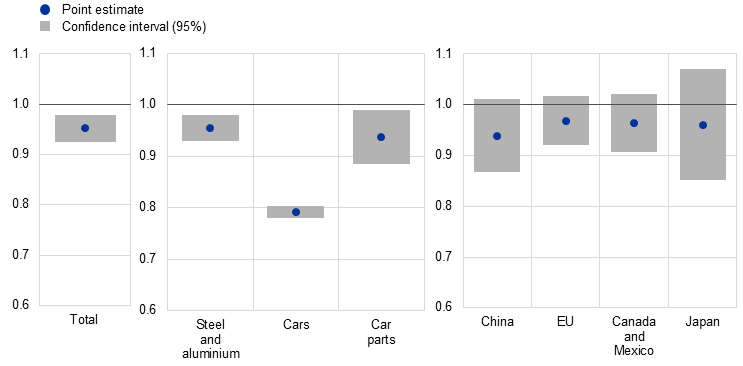
Exporters to the United States are absorbing only a small fraction of higher tariff-related costs. In aggregate, unit values of imported goods reported net of tariffs show an average pass-through coefficient of 0.95 (Chart A, panel a).[2] This means that a 10% increase in tariffs implies only a 9.5% increase in prices. Therefore, only a small fraction of the increased tariffs is being absorbed by exporters.[3] The pass-through coefficient is significantly lower when looking at specific sectors.[4] However, no significant differences are evident in the estimated tariff pass-through by major trading partners.
Chart A
Impact of tariffs on unit values and volumes of imported goods
a) Unit values of imported goods
(elasticity; complete pass-through = 1)
b) Volumes of imported goods
(elasticity)
Source: ECB staff calculations.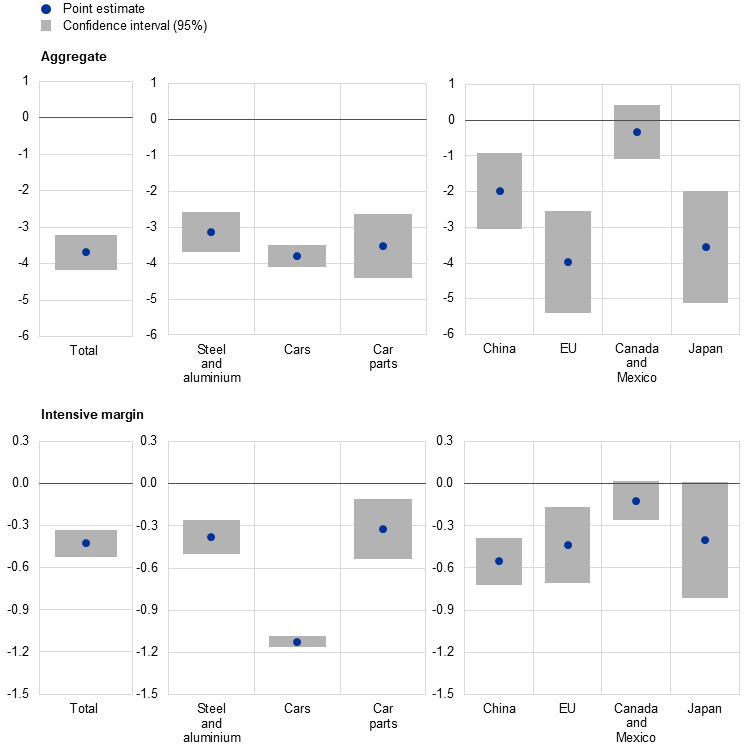
Notes: The reported estimates are based on a panel regression analysis of six-digit product categories of the harmonised system (HS6) import unit values, following the methodology of Amiti et al. (2019). Estimated on a sample from January 2024 to October 2025. The upper part of panel b) reports estimates of the aggregate elasticity (extensive and intensive margin) obtained from a regression where product categories, including those subject to higher tariffs, are no longer imported into the United States. The lower part of panel b) reports estimates obtained from a regression on those product categories which are still traded under tariffs.
The estimated impact of tariffs on import volumes is large. The estimated aggregate elasticity of imports for all product categories stands at -3.7. This means that a 10% increase in tariffs would result in a 37% decline in import volumes. If, by contrast, we focus on only those product categories which are still traded under tariffs, the estimated coefficient declines markedly, albeit remaining economically relevant at ‑0.43. This means that a 10% increase in tariffs would result in a 4.3% decline in import volumes. This difference in estimated elasticity for import volumes suggests that the observed decline is largely associated with products which, in response to tariffs, are no longer traded – meaning they undergo an adjustment through the extensive margin (Chart A, panel b, upper graph). However, volumes also decline markedly for products which are still being traded under tariffs (trade adjustment through the intensive margin; Chart A, panel b, lower graph).
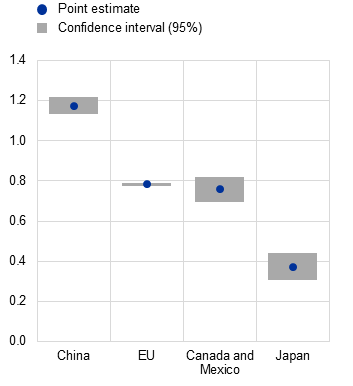
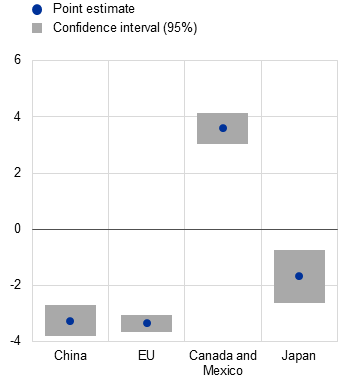
Zooming in on the automotive sector highlights how tariffs triggered significant changes in trade structures, particularly within regional supply chains. In the automotive sector, the results point to a clear decoupling of the United States from China and the EU in favour of Canada and Mexico (Chart B). The surge in car imports from Canada and Mexico reflects a strengthening of existing trade relationships.[5] This stands in sharp contrast to the results reported for the EU and Japan, which saw both a contraction in the unit value of exported cars and a strong decline in the volume of products subject to tariffs and still exported to the United States.[6]
Chart B
Impact of tariffs on unit values and volumes of cars imported to the United States
|
a) Unit values of imported cars |
b) Volumes of imported cars |
|---|---|
|
(elasticity; complete pass-through = 1) |
(aggregate elasticity) |
 |
 |
Source: ECB staff calculations.
Notes: The reported estimates are based on a panel regression analysis of six-digit product categories of the harmonised system (HS6) import unit values, following the methodology of Amiti et al. (2019). Estimated on a sample from January 2024 to October 2025.
While tariffs are reshaping the geography of trade relations with the United States, their costs are falling mostly on domestic importers and consumers. We find that costs associated with higher tariffs are passed down the pricing chain, with consumers currently bearing around a third of the tariff burden (Chart C). And if the higher tariffs are expected to stay in place for a longer period, the available survey evidence from US firms suggests that they will pass a larger share of tariff-related costs on to consumers. Over the longer term, this share could rise to over half as US firms exhaust their ability to absorb costs. Additionally, if the extent to which exporters absorb tariffs remains limited in scope, as reported above, this implies that US firms would absorb around 40% of higher tariff costs in the longer term.
Chart C
Distribution of tariff-implied costs along the pricing chain
(coefficient estimates)
Source: ECB staff calculations.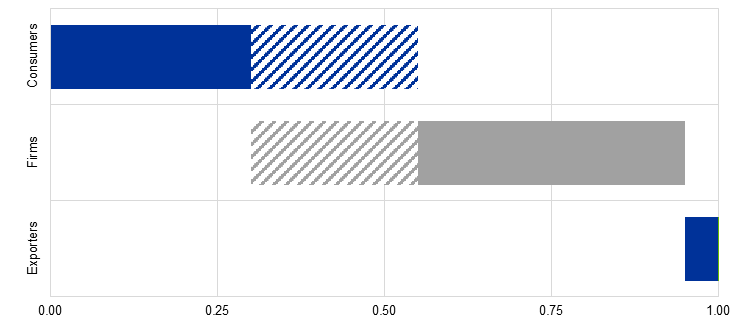
Notes: The chart shows how tariff costs are distributed across the pricing chain, based on empirical analyses using data available up to August 2025 (dark blue). The grey bars represent residual attributions, with hashed sections indicating survey results from Andrade et al. (2025), which suggest that the tariff pass-through to consumers increases to 0.55 when in place over longer time horizons. The figure for consumers is derived from a panel regression of tariffs on personal consumption expenditures PCE components, while the figure for exporters is based on a panel regression analysis of six-digit product categories of the harmonised system (HS6) import unit values, following the methodology of Amiti et al. (2019). “Firms” refers to distributors, producers and retailers.
References
Amiti, M., Redding, S.J. and Weinstein, D.E. (2019), “The Impact of the 2018 Tariffs on Prices and Welfare”, Journal of Economic Perspectives, Vol. 33, No 4, pp. 187-210.
Amiti, M., Flanagan, C., Heise, S. and Weinstein, D.E. (2026), “Who Is Paying for the 2025 U.S. Tariffs?”, Liberty Street Economics, Federal Reserve Bank of New York, 12 February.
Andrade, P., Dietrich, A.M., Leer, J., Lin, X., Schoenle, R.S., Tang, J. and Zakrajšek, E. (2025), “Who Will Pay for Tariffs? Businesses’ Expectations about Costs and Prices”, Current Policy Perspectives, No 25-13, Federal Reserve Bank of Boston, 29 September.
Hinz, J., Lohmann, A., Mahlkow, H. and Vorwig, A. (2026), “America’s Own Goal: Who Pays the Tariffs?”, Kiel Policy Brief, No 201, Kiel Institute for the World Economy.
Le Roux, J. and Spital, T. (2026), “Global trade redirection: tracking the role of trade diversion from US tariffs in Chinese export developments”, Economic Bulletin, Issue 1, ECB.
-
There is a difference between statutory and actual effective tariff rates. The statutory effective tariff rate is calculated based on tariff announcements and a usually fixed trade structure, whereas the actual tariff rate is derived from customs data and is typically lower. The World Trade Organization reports in its tariff tracker that the statutory effective tariff rate on goods for the United States was 18.2% in November 2025, whereas the actual effective tariff rate on goods for the same month was 9.8%. For economic analysis, the statutory effective tariff rate is typically used as the explanatory variable as the implementation date is judged to be more relevant compared with customs reports data, which often suffer from reporting lags and endogeneity bias caused by changing trade volumes triggered by tariffs.
-
Aggregate effects are captured through time fixed effects, while product-level characteristics are controlled for by including item fixed effects following Amiti et al. (2019). The tariff effect is identified by the common movement of the dependent price variable in response to tariff changes within all items across time.
-
This finding is broadly consistent with the evidence from the 2018-19 period as documented in Amiti et al. (2019). It is also in line with the available estimates for the current tariffs (Hinz et al., 2026), suggesting that the United States possesses limited terms-of-trade leverage over its global suppliers in the short term. While Amiti et al. (2026) report a similar tariff pass-through (elasticity) of 0.94 for the period from January to August 2025, they find it declined to 0.86 in November.
-
Steel and aluminium, cars and car parts were targeted early on by the US Administration and faced significant tariffs ranging from 25% to 50%, with few exemptions.
-
Rerouting of Chinese car exports via these countries may have contributed to these developments, although recent analyses suggest that Chinese exports may have been rerouted through countries in the Association of Southeast Asian Nations. For further details, see Le Roux and Spital (2026).
-
The estimated elasticity on the trade volume at the intensive margin is 0.84 for Canada and Mexico and ‑1.26 for the EU.
Compliments of the European Central Bank